Thousands of PDFs in. Boardroom-ready risk signals out.
A full-stack financial analytics platform, built solo: a serverless document pipeline turns thousands of raw invoices a month into clean, validated records, and a SQL-backed metrics layer turns those records into C-suite dashboards, drill-downs, and predictive risk scores. The unglamorous part — getting messy PDFs to trustworthy numbers — is exactly where the engineering lives.
 TypeScript
  React
React  Azure
Azure  SQL Server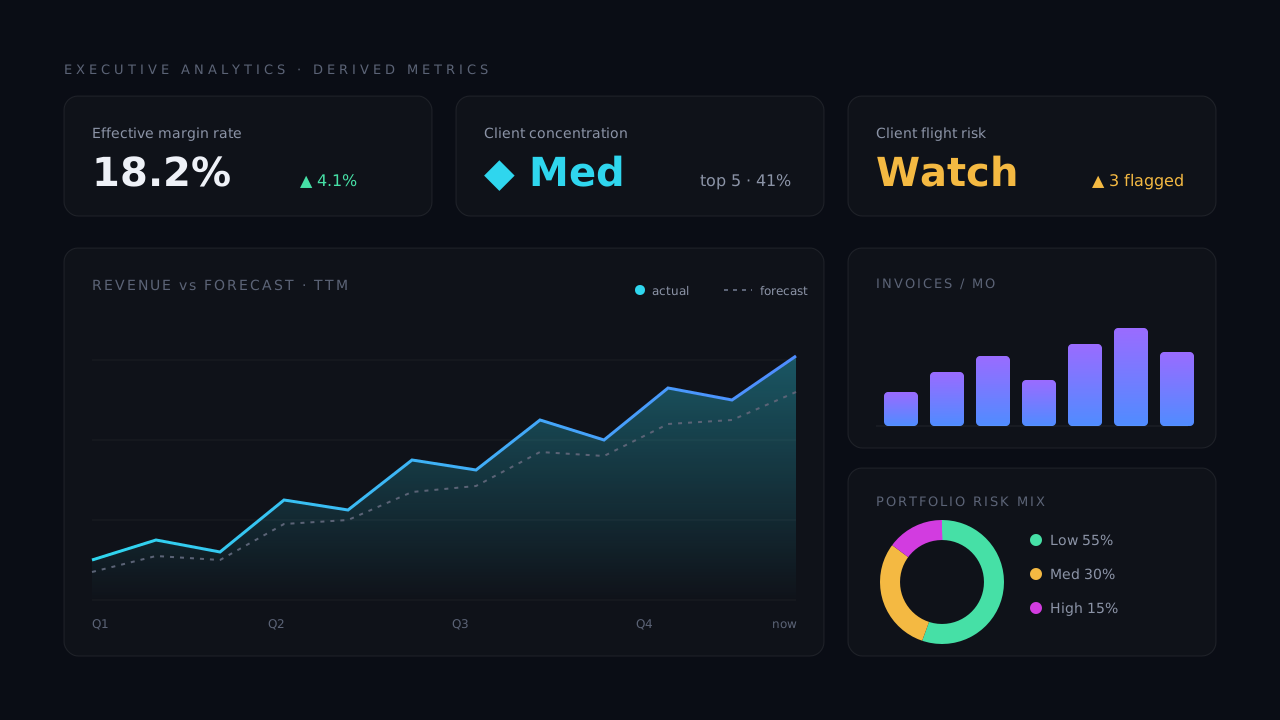
The numbers leadership wanted were trapped inside PDFs.
The data that mattered most — margins, concentration, who's quietly drifting away — was buried in thousands of invoices and payment documents arriving every month as PDFs. Pulling a single executive answer meant someone re-keying figures by hand, and every dashboard built on that was only as honest as the last manual export.
The goal was a platform where raw documents become validated records automatically, those records feed a governed metrics layer, and leadership gets dashboards and drill-downs they can actually trust — without anyone retyping a number. That meant solving extraction, validation, and modeling as one pipeline, not three disconnected scripts.
Documents in, validated metrics out.
A serverless pipeline does the extraction; SQL does the math; React does the storytelling.
The risk metrics, not the chart library.
Three derived signals computed on top of the validated data — generic by design, no client specifics.
Effective Margin Rate
A normalized margin computed across the portfolio rather than read off any single invoice — built in SQL so the definition is consistent everywhere it's shown, from the executive headline down to the drill-down.
Client Concentration Risk
How dependent the book is on its largest relationships. A structural risk signal that's easy to ignore when you only look at totals, and obvious once it's modeled and surfaced as a first-class metric.
Client Flight Risk Score
A predictive score that flags relationships trending toward churn from changes in behavior over time — the one signal leadership most wants early, derived on the same validated foundation as everything else.
The deliberate choice throughout was to compute metrics in SQL, close to the validated data, instead of scattering business logic across the front end. One definition of "margin" or "concentration," reused by every dashboard and every drill-down — so a number on the executive screen and a number three clicks deep can never quietly disagree.
Because the platform is under NDA, this write-up stays at the level of architecture and engineering approach: the document pipeline, the human-in-the-loop validation, and how the risk metrics are derived. No real client names, figures, or screenshots — the dashboard above is an illustrative mock. Want to talk through the approach? Reach out →